My Research
Understanding How Planets Form
I study how planets are born. Planets form in protoplanetary disks—swirling disks of gas and dust around very young stars, about thousand times younger than the Sun! My work focuses on how these disks evolve and eventually clear out, leaving behind planets. By directly imaging the gas flowing in these disks (jets and winds), we can see the same physical processes that shaped our own solar system about 4.6 billion years ago.
Protoplanetary Disk Evolution
▼The Mystery of Disk Accretion
Planets form in disks of gas and dust surrounding young stars, where material accretes inward to build both the star and emerging planets. However, efficient accretion requires the removal of angular momentum, a long-standing challenge in disk physics.
For many years, turbulence driven by the magnetorotational instability (MRI) was thought to be the primary mechanism enabling accretion. Yet observations and numerical simulations now show that MRI is ineffective over much of the disk, where the gas is too cold and weakly ionized to sustain strong magnetic coupling.
So if MRI can't do the job, what can? An alternative mechanism is magnetohydrodynamic (MHD) disk winds, in which magnetic fields launch material from the disk surface while extracting angular momentum. By removing angular momentum through outflows, these winds allow the remaining disk material to accrete inward.
Seeing the Invisible: The Nested Structure of Disk Winds
Theory predicts that if MHD winds are present, they should exhibit a distinctive "nested" structure, with different layers moving at different speeds and having different temperatures. These layers are expected to originate from different regions of the disk, with the hottest components launching from radii as small as ~1 au and the coldest components from distances as large as ~30 au.
But observations of this structure remained rare, with only a few discovered before JWST. Working with Prof. Ilaria Pascucci and an international team, we pointed JWST's NIRSpec instrument at four edge-on protoplanetary disks in the Taurus star-forming region. What we saw was stunning.
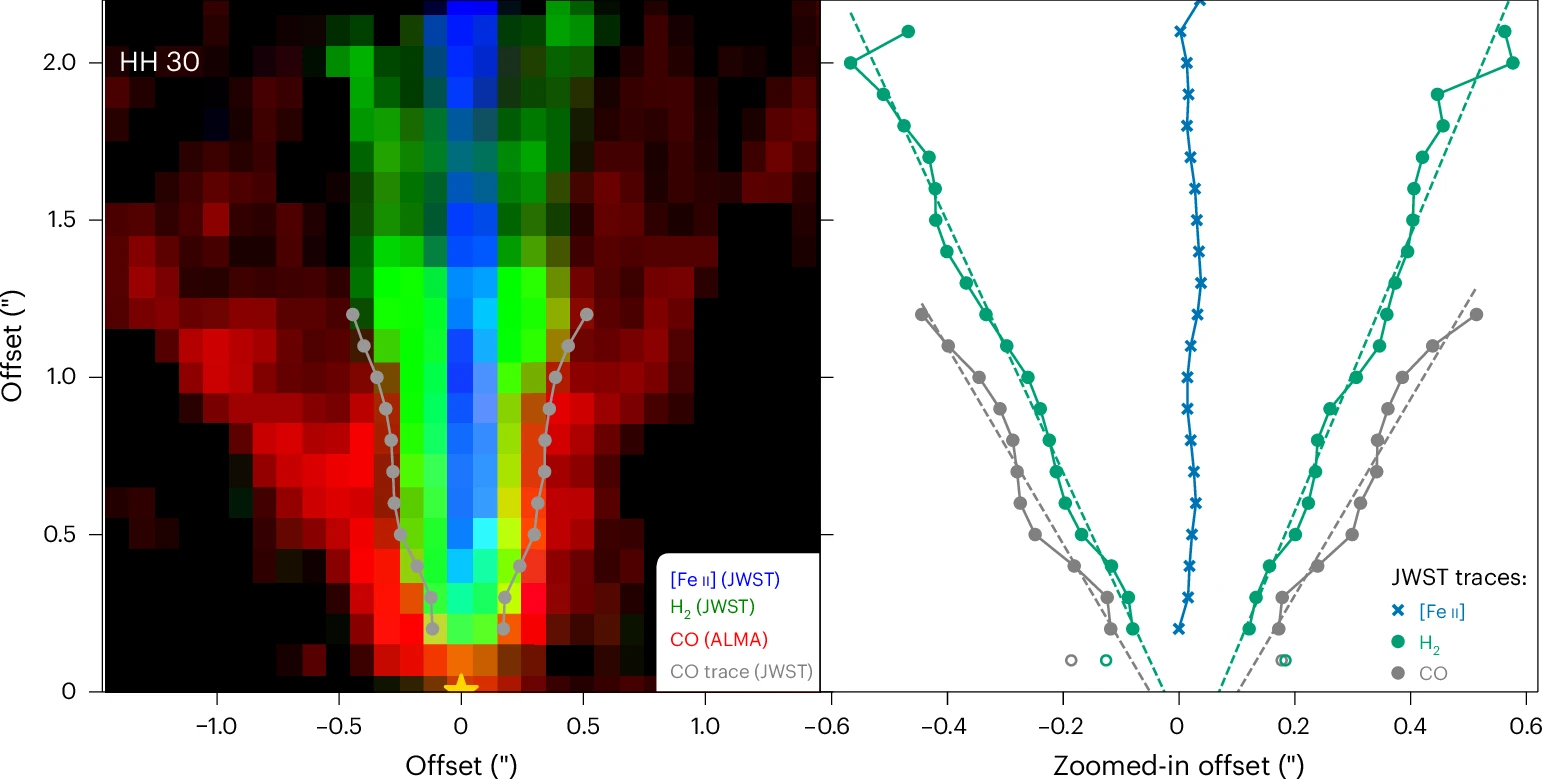
JWST/NIRSpec reveals the nested structure of disk winds in HH 30: a fast [Fe II] jet at the center, surrounded by slower H₂ emission, with broader CO emission at the edges.
In every disk we observed, the predicted nested wind structure is unambiguously detected. Fast iron jets nested inside hollow hydrogen wind, arranged precisely as expected from MHD wind models. We measure wind launching radii of ~1–10 astronomical units, directly within the planet-forming region of the disk.
What We Discovered
This was the first time anyone had directly imaged the layered structure of MHD disk winds with a strong constrain on the launch radius. It's not just one disk—it's all four we looked at, suggesting that MHD winds are common, perhaps even universal, in protoplanetary disks. This fundamentally changes how we understand disk evolution and the environments where planets form.
Measuring the Flow: Jets, Accretion, and Hidden Companions
The fact that we observed MHD disk winds in all four disks that we targeted raises a question: Were our observations biased to sources with highest accretion rate and hence, strongest winds? or are these MHD disk winds really common? The only way to answer this question was to calculate the accretion rates for each of these disks and compare with disks around similar stars to check if they are similar.
That's exactly what we did in a study that I led -- Using over 30 different forbidden emission lines, we first calculated that these jets are losing about 10-9 solar masses per year. Using this, we estimated the accretion rate for all four of our sources and found them to be typical of the Taurus star-forming region, where these stars recide.
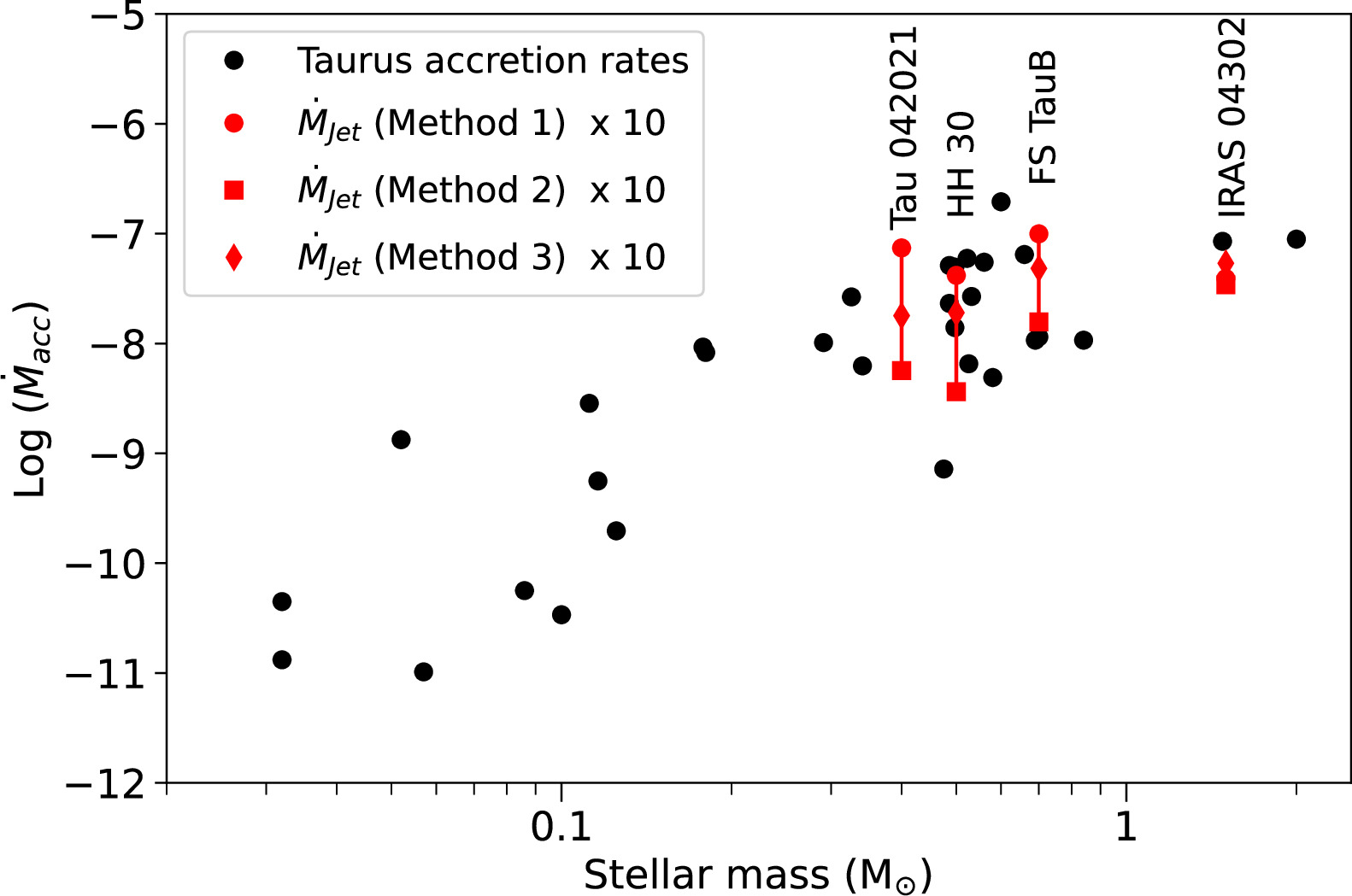
Accretion rates estimated from jet mass-loss for four edge-on disks (red stars) compared to other disks in Taurus. Our targets are typical—meaning MHD winds are common, not rare anomalies.
But the jets revealed more than just mass loss. In one system, Tau 042021, I noticed something odd: the jet was wiggling—oscillating side to side in a mirror-symmetric pattern. This wasn't random. It was the signature of a hidden binary companion, pulling the jet-launching star in a 2.5-year orbit. JWST had revealed a companion star that no one knew was there.
We also found that the jets are intrinsically asymmetric—one side is brighter than the other, and it's not because of dust blocking the light. It's something fundamental about how the jets are launched, a clue we're still working to fully understand.
Why This Matters
Before this study, the question was whether MHD winds drive accretion in the disk at all. After these studies, the question has now changed to "How much of the total accretion is driven by MHD winds", because their presence means they are driving some level of accretion. We have ongoing efforts to answer this updated question!
Protoplanetary Disk Dispersal
▼The Final Act: How Disks Die
Protoplanetary disks don't last forever. Within a few million years, the gas—the fuel for giant planet formation—vanishes. Once the gas is gone, no more Jupiters or Saturns can form. Rocky planets can still assemble from leftover dust, but the window for gas giants closes.
Astronomers have long theorized that photoevaporative winds—driven by intense X-rays and extreme ultraviolet (EUV) radiation from the central star—are responsible for clearing the gas. The high-energy radiation from the star heats the disk surface until gas molecules move fast enough to escape the star's (and disk's) gravity entirely.
This process determines the fate of planetary systems. Clear the gas too early, and you get a system with more rocky planets and maybe a few gas giants. Clear it too late, and you might end up with multiple giant planets. Photoevaporation sets the clock.
But for 30 years, we only had spectral evidence of these winds. No one had ever directly seen a photoevaporative wind clearing a disk—until my team used JWST to look at T Chamaeleontis.
The First Image: Watching a Disk Evaporate
Using JWST's Mid-Infrared Instrument (MIRI), we conducted targeted observations of noble gas emission lines, specifically neon and argon. These species are powerful tracers of disk winds: they remain in the gas phase, emit strongly when ionized by stellar X-ray and UV radiation, and their spatial and kinematic signatures directly reveal both the location of the wind and its driving mechanism.
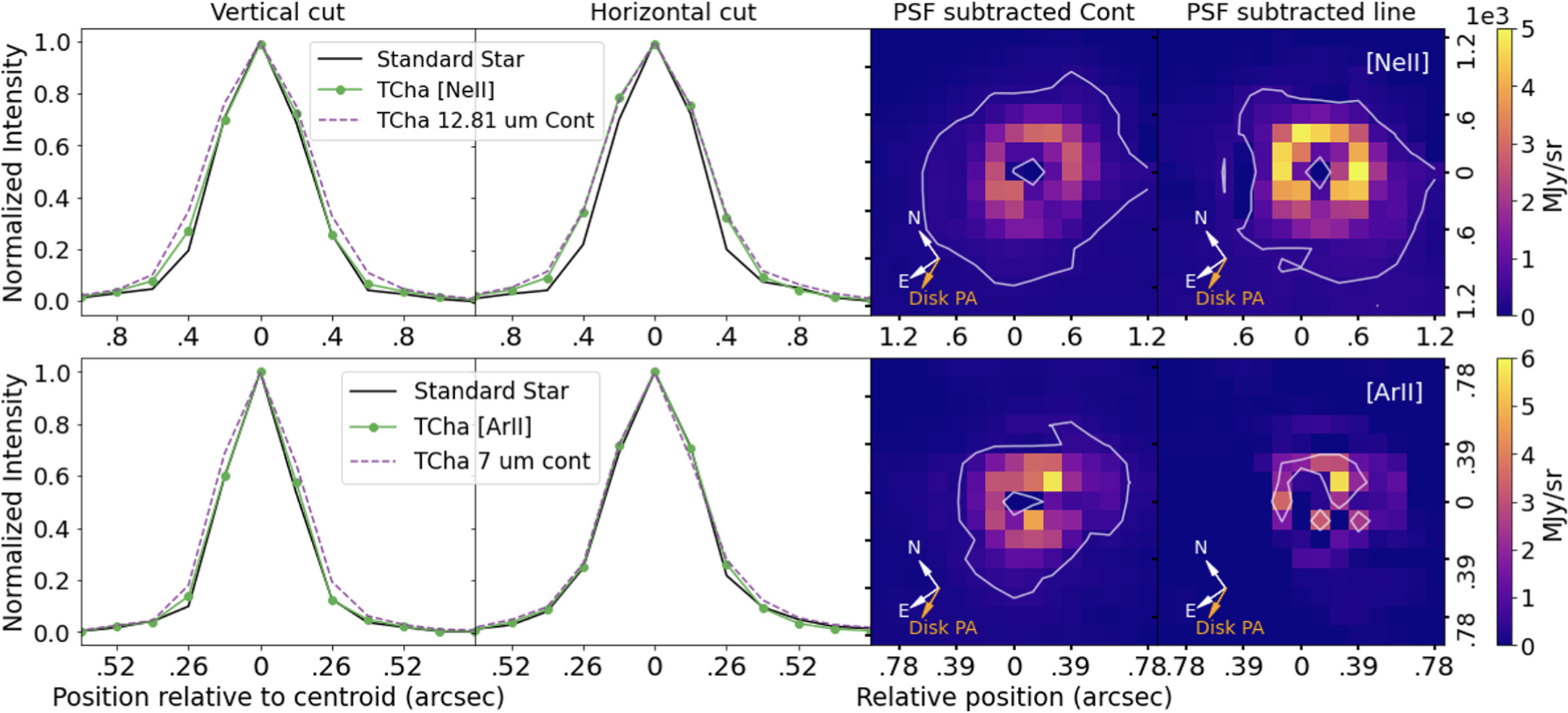
The first direct image of a photoevaporative wind: JWST/MIRI reveals spatially extended [Ne II] emission from T Cha—gas being blown away by the star's high-energy radiation.
What we saw was groundbreaking. The [Ne II] emission was spatially extended—it wasn't just a point source at the star; it spread out across and above the disk. This was direct, visual proof that gas was being launched from the disk surface and escaping into space.
A 30-Year Question Answered
This was the first spatially resolved detection of a photoevaporative disk wind. After three decades of theory and indirect evidence, we finally saw it happening. T Cha's disk is being cleared by radiation-driven winds, and we watched it in action.
Understanding the Wind: Models Meet Reality
Seeing the wind was the first step. Understanding its physics required sophisticated modeling. Working with Dr. Andrew Sellek and collaborators, we used hydrodynamic simulations combined with radiative transfer calculations to interpret what we saw.
The models revealed that the wind is dense—much denser than expected, with electron densities around 10,000–100,000 particles per cubic centimeter. It launches from about 1 AU from the star and extends outward beyond 10 AU.
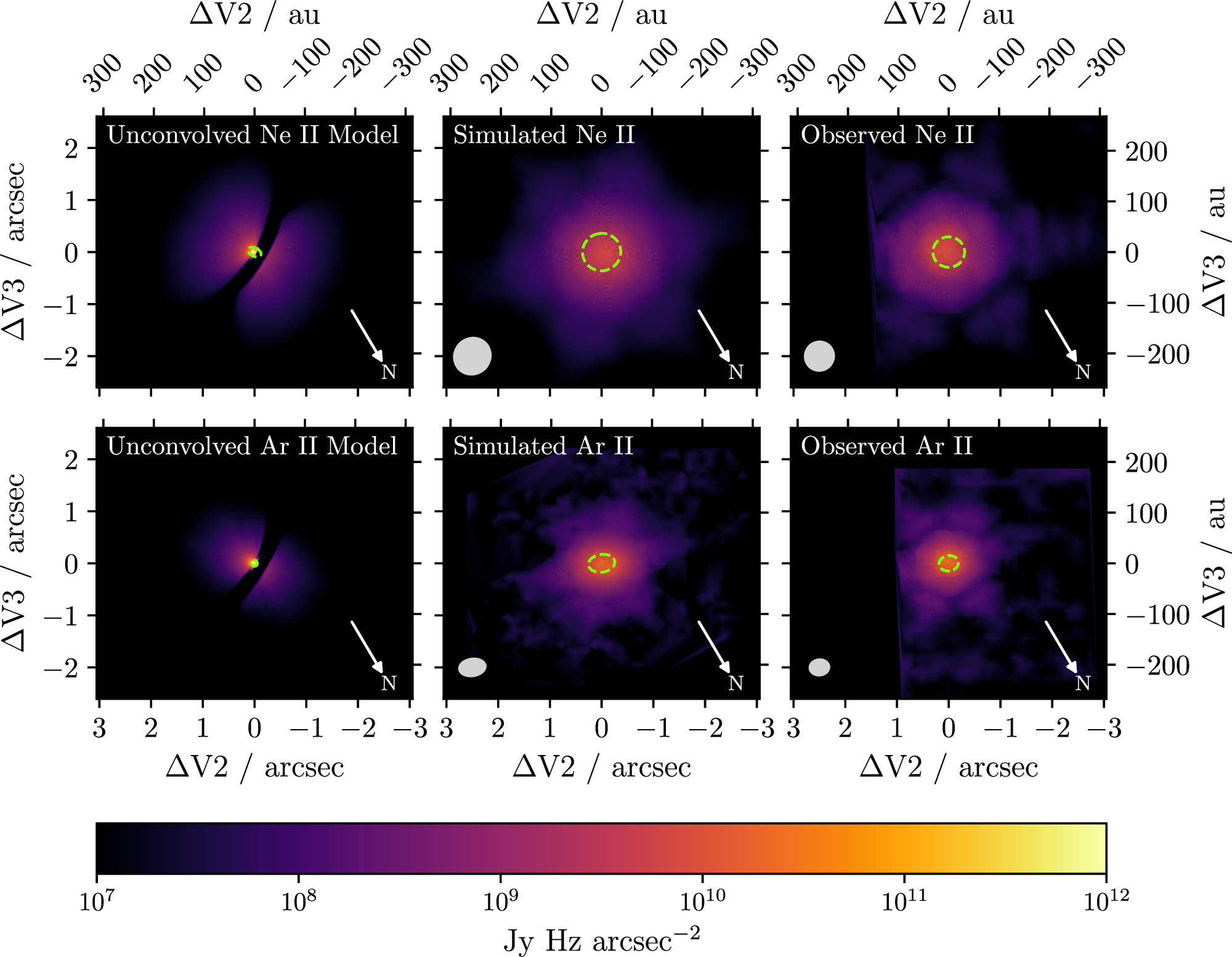
Hydrodynamic models of photoevaporative winds, combined with radiative transfer and synthetic JWST observations, reproduce the observed noble gas emission and constrain the wind's density and launching region.
The compact [Ar II] emission compared to the extended [Ne II] emission told us something critical: the wind is so dense that it shields itself from soft X-rays, creating distinct ionization zones. Hard X-rays penetrate deep and ionize neon everywhere, but softer photons are absorbed in the wind's outer layers, ionizing argon only in specific regions.
This shielding effect is a hallmark of thermal photoevaporation—the wind is driven by heating, not magnetic fields. In T Cha's outer disk, at least, photoevaporation is the dominant clearing mechanism.
From Detection to Understanding
By combining JWST observations with state-of-the-art models, we didn't just see the wind—we measured its density, temperature, ionizing radiation, and launching radius. This is the first detailed physical characterization of a photoevaporative wind, giving us the tools to understand how disk gas is cleared and how that impacts planet formation.
Circumbinary Disk Evolution
▼Disks Around Double Stars: A New Frontier
Most stars aren't alone—many have binary companions, two stars orbiting each other. When a protoplanetary disk surrounds both stars, we call it a circumbinary disk. These systems are fascinating laboratories as more and more planets are being discovered orbiting them, raising the question -- how do planets form around a binary?
The orbiting binary carves a large gap in the inner disk. This affects how material accretes onto the stars, how winds are launched, and how planets can form. And turns out, it can all change depending on how far apart the two stars are from each other
My work on circumbinary disks is in its early stages, hence, this section is under development.
Early Results
Using JWST, we have observed the circumbinary disk around V4046 Sgr and we are investigating it in a similar manner to T Cha to understand photoevaporation. We have discovered both atomic and molecular winds in this system -- these results will soon be published.
The Next Chapter
This research is ongoing, and JWST is giving us the first detailed views of how circumbinary disks evolve. Over the next few years, I'll be analyzing more systems, comparing them to single-star disks, and working to understand how planets form in these dynamic, double-star environments. Please get in touch if this topic interests you -- I look forward to fruitful discussions and possible collaborations on this topic.